5G is still rolling out and 6G is already being hyped. Here’s an honest breakdown of what’s actually different between them and what it means for your life.
5G vs 6G: What’s Actually Different and When Will It Matter?
You might still be waiting for 5G coverage in your area. And you’ve already started seeing headlines about 6G.
If that feels exhausting, I get it. The wireless industry has a well-earned reputation for overselling future technology while the current rollout is still incomplete and underperforming expectations.
But there’s genuinely interesting stuff happening in the wireless space that’s worth understanding — not because you need to rush out and buy a new phone, but because the connectivity decisions being made now will shape the next decade of technology.
Here’s the unexaggerated version.
What 5G Actually Delivers (When It Works)
Let’s start with where we are. 5G has been rolling out for several years now and the results are… mixed, depending heavily on where you live and which type of 5G you’re getting.
There are actually three different frequency bands in 5G deployments, and they perform very differently:
Low-band 5G uses the same frequencies as 4G LTE. It covers wide areas including rural regions and penetrates buildings well. The speeds? Often barely faster than good 4G. This is what many people are getting when their phone shows a “5G” icon.
Mid-band 5G (the sweet spot) delivers real-world speeds 5-10x faster than 4G, with reasonable coverage and building penetration. This is deployed widely in major cities and is genuinely impressive when you’re in range.
mmWave 5G (millimeter wave) is the stuff from the original hype reel — gigabit speeds, ultra-low latency, essentially unlimited bandwidth density. It also barely penetrates walls, has a range of a few hundred meters, and is deployed only in very specific locations like sports stadiums and dense downtown blocks.
Most people’s experience of 5G falls somewhere between “this feels like 4G” and “this is genuinely fast.” Almost nobody outside of specific locations is experiencing mmWave’s peak performance.
The Use Cases 5G Is Actually Enabling
Despite the overhype, 5G is enabling real things that 4G couldn’t:
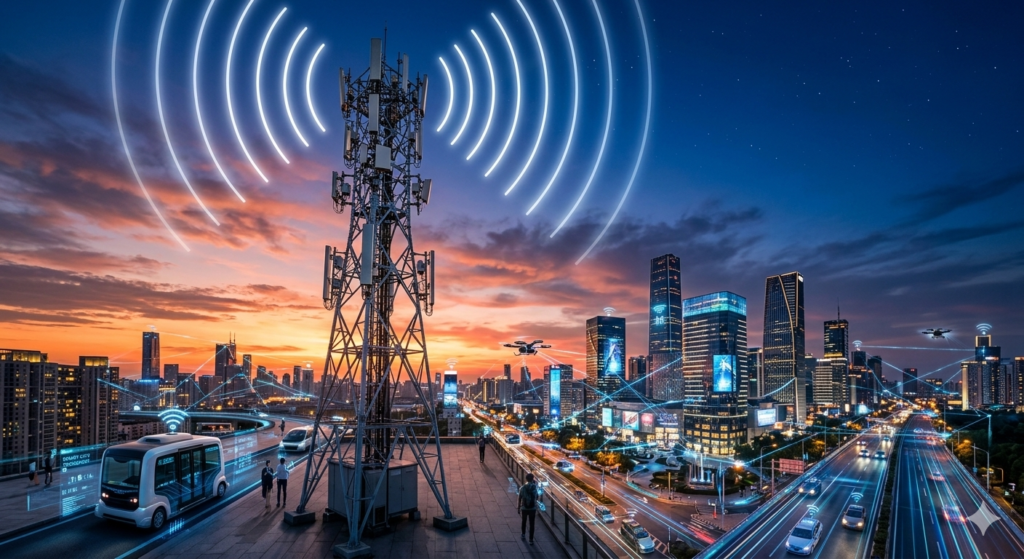
Autonomous vehicle communication. The ultra-low latency of proper 5G deployments allows vehicles to communicate with each other and with infrastructure in near-real-time. V2X (vehicle-to-everything) technology requires this.
Industrial IoT. Factories using 5G-connected sensors and robots are already operational. The bandwidth density to handle thousands of connected devices in a small space is genuinely only possible with 5G.
Remote surgery and telemedicine. Procedures where latency of even 100 milliseconds is too much — robotic surgery being the most dramatic example — become viable with 5G.
For most consumers, though, the primary benefit of 5G in daily use is just faster streaming and more reliable connections in crowded areas. Not nothing — but also not the revolution that was promised.
So What’s 6G?
6G is still a research and standards concept. No consumer 6G networks exist. The International Telecommunication Union (ITU) is working on standards, major universities and companies are doing early research, and first-generation 6G networks are expected around 2030 at the earliest.
Here’s what researchers are targeting:
Speed: Peak theoretical speeds of 1 terabit per second — roughly 100x faster than 5G’s theoretical peak, and millions of times faster than current average connection speeds.
Latency: Sub-millisecond (under 1ms) latency. 5G targets around 1ms, 4G is typically 20-50ms. At sub-1ms, the distinction between “real” and “transmitted” data disappears from human perception.
AI integration: 6G is being designed with artificial intelligence as a native component of the network, not a layer on top. Networks that can predict and adapt to usage patterns dynamically.
Spectrum: 6G will use terahertz frequencies — even higher than mmWave 5G — for the highest performance applications.
When Does 6G Actually Matter to You?
The honest timeline: early 6G deployments in major cities may begin around 2030-2032. Widespread meaningful coverage is probably 2035+.
By then, the applications that take advantage of it — always-on spatial computing (think AR glasses that are actually good), seamless holographic communication, truly immersive remote experiences — may be ready to use that bandwidth.
For right now? If 5G is available in your area with mid-band coverage, upgrading makes sense for the speed improvement. If you’re only getting low-band 5G, there’s almost no reason to specifically seek out a 5G device over a good 4G one.
And don’t stress about 6G for at least another five years. By then, the 5G rollout may have even reached your neighborhood.