
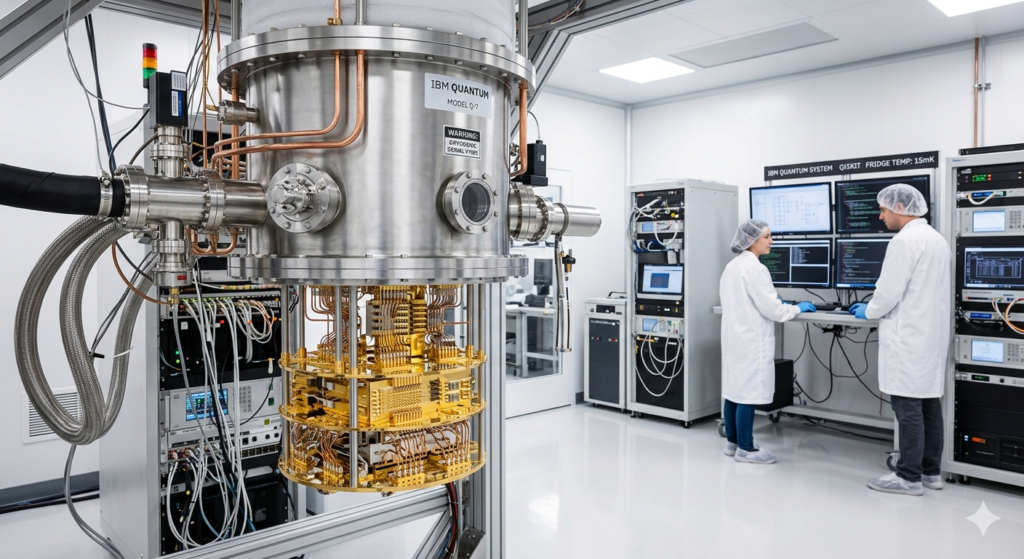
Quantum computing is no longer just a lab experiment. Here’s a plain-English breakdown of what it is, where it’s going, and why it matters to you.
What Is Quantum Computing and Why Should You Actually Care?
Every few months, a headline announces that quantum computing has achieved some new milestone and will “change everything.” And then… nothing seems to visibly change. Your laptop still works the same way. Your phone still runs the same apps.
So what’s actually going on with quantum computing? Is it real? Is it close? And does it actually matter to anyone outside of a physics PhD program?
Here’s the honest explanation — no degree required.
The Classical Computer Explanation (Bear With Me)
The computer you’re using right now — phone, laptop, desktop — is a classical computer. At the most fundamental level, it processes information as bits. A bit is either 0 or 1. Off or on. Every calculation your computer makes, every pixel on your screen, every character in this article — all of it breaks down to strings of 0s and 1s.
This works extraordinarily well for most things. Classical computers are fast, reliable, and increasingly powerful. They’ve given us everything from the internet to GPS to modern medicine’s diagnostic tools.
But there are categories of problems where classical computers hit a wall. Problems where the number of possible solutions is so astronomically large that it would take a classical computer longer than the age of the universe to work through them.
This is where quantum computing enters.
The Qubit Difference
A quantum computer uses qubits instead of bits. And here’s where things get weird — but stay with me.
A classical bit is either 0 or 1. A qubit, thanks to the quantum mechanical property called superposition, can be 0 and 1 simultaneously — until it’s measured. At that point, it “collapses” to one value.
What this means in practice: a quantum computer working with qubits can explore many possible solutions simultaneously rather than testing them one by one. The computational power scales exponentially with each additional qubit. This gives quantum systems the potential to solve certain categories of problems that are essentially impossible for classical computers.
There’s a second property called entanglement — when two qubits become correlated in a way where the state of one instantly affects the other regardless of physical distance. This allows quantum computers to coordinate calculations in ways that have no classical equivalent.
Where Quantum Actually Outperforms Classical
Quantum supremacy — the point at which a quantum computer can solve a specific problem faster than any classical computer — has already been demonstrated. Google did it in 2019 with a specialized problem. IBM and others have followed.
But it’s worth being specific about where quantum advantage actually applies, because marketing hype has created confusion:
Drug discovery and molecular simulation. Modeling the behavior of complex molecules is exactly the kind of problem quantum computers are built for. Classical computers can only approximate; quantum computers can simulate molecular interactions at the quantum level. The implications for pharmaceutical research are enormous.
Optimization problems. Logistics companies routing thousands of deliveries, financial firms balancing enormous portfolios, energy grids managing supply and demand in real time — all of these involve optimization problems with astronomical numbers of variables. Quantum approaches could find optimal solutions dramatically faster.
Cryptography. This is the scary one. Current encryption standards rely on the fact that classical computers would take impractical amounts of time to factor large prime numbers. A sufficiently powerful quantum computer could do this quickly — breaking most current encryption. This is why governments and tech companies are rushing to develop “quantum-resistant” cryptography standards.
What quantum can’t do better: Word processing. Web browsing. Gaming. Streaming video. The everyday computing tasks of modern life don’t benefit from quantum approaches. These domains stay classical.
Where Are We Actually At?
Here’s the honest reality check. Current quantum computers are what researchers call NISQ devices — Noisy Intermediate-Scale Quantum systems. They work, but they’re error-prone. The qubits are incredibly fragile, requiring cooling to near absolute zero, and quantum states collapse (“decohere”) easily from environmental interference.
The roadmap to fault-tolerant, large-scale quantum computing useful for real-world applications is still being built. Most experts estimate meaningful commercial quantum advantage in important problem domains is 5–15 years away for many applications.
But the progress has been real and the investment has been massive. IBM, Google, Microsoft, and a wave of quantum startups are all building toward this future.
Why Regular People Should Pay Attention
You may never directly use a quantum computer. But you’ll feel its effects:
Your medicines will be better, developed with molecular simulations previously impossible. Your logistics costs — baked into the price of nearly everything you buy — will drop. Climate modeling will improve, potentially accelerating climate technology. And yes, your encryption will need to be updated — which is a major effort already underway.
Quantum computing isn’t a curiosity for physicists. It’s an infrastructure technology that will reshape industries from healthcare to finance to national security.
The timeline is longer than the hype suggests. The impact, when it comes, will be larger.