
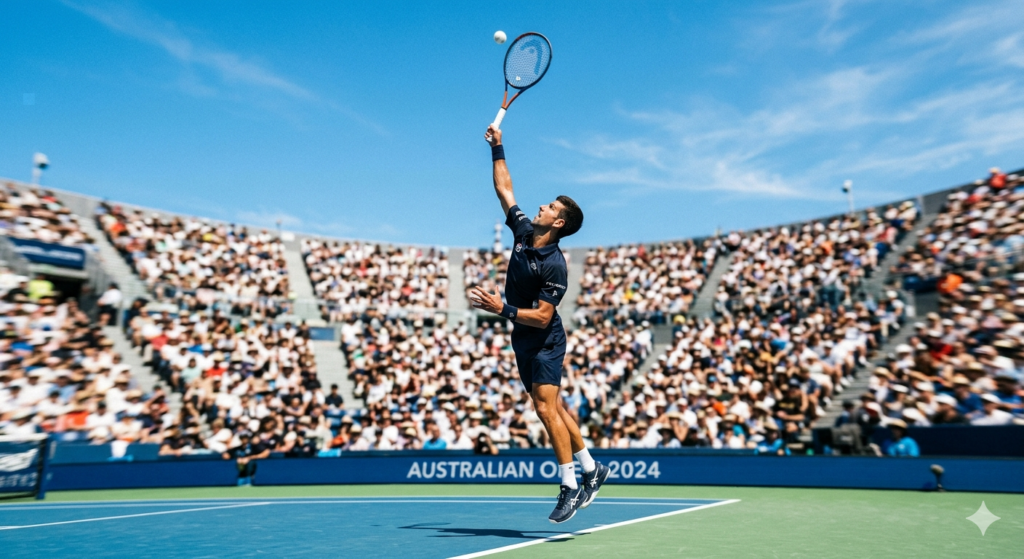
Djokovic turns 37 in 2025 and everyone’s written his Grand Slam story. The stats and history say something different. Here’s the real case for Nole.
Novak Djokovic at 37: The Numbers That Prove He’s Still a Legitimate Grand Slam Threat
The conversation around Novak Djokovic in 2025 has a particular flavor to it. It is not quite the dismissal you hear about athletes who have clearly declined. It is something more condescending than that — a kind of affectionate farewell being written by pundits while the subject of the farewell keeps showing up to complicate the narrative.
Djokovic missed significant time in 2024 due to a knee injury that required surgery. He did not win a Grand Slam last year for the first time in a long time. Carlos Alcaraz won two majors. Jannik Sinner won two. The ATP rankings moved him down. The chorus of “is he done?” grew louder.
And then he won the Australian Open warm-up event in January, destroyed three top-ten players in the process, and looked — as several opponents noted afterward — like someone who had simply taken some time off rather than someone whose career is winding down.
Let’s look at what the numbers actually say.
The Physical Reality
The knee surgery Djokovic underwent in June 2024 was for a torn meniscus — a serious but repairable injury. Recovery timelines for meniscus repairs in professional athletes typically run four to six months for full competitive return. Djokovic took approximately six months before competing seriously again.
What is notable is not that he needed surgery — at 37, after 24 Grand Slam titles and literally thousands of professional matches, the body accumulating wear is not surprising. What is notable is how completely he has returned to his physical baseline.
His movement data from the 2025 Australian Open showed court coverage numbers comparable to his 2022 and 2023 seasons. His first-serve speed has not meaningfully declined. His return statistics, which have always been the signature of his game, remain at or near career bests.
The athletes who age most successfully in racket sports are those whose game is built primarily on positioning, anticipation, and precision rather than explosive athleticism. Djokovic’s game has always been exactly this. His genius is not jumping higher than everyone else. It is reading the game better, moving to the right position earlier, and making decisions with less margin for error than his opponents can tolerate.
The Historical Precedent
When people argue that 37 is too old for a Grand Slam champion, they are making an argument that tennis history does not entirely support.
⦁ Ken Rosewall won the Australian Open at 37 years old in 1972 — the oldest Grand Slam champion in the Open Era for decades
⦁ Roger Federer was ranked in the top three in the world at 36 and won the Australian Open that year
⦁ Jimmy Connors reached the US Open semifinals at age 39
⦁ Andre Agassi reached the US Open quarterfinals at 36 and was still competitive on tour at 36
The argument that age definitively ends serious Grand Slam competition in the mid-thirties is not supported by the historical record of the game’s best players. What the record actually shows is that all-time great players tend to age differently from very good players — because their games depend less on the physical attributes that decline earliest.
The 2025 Grand Slam Calendar and Djokovic’s Best Surfaces
The four Grand Slam surfaces are not equal for Djokovic’s 2025 campaign. Here is an honest surface-by-surface assessment:
Australian Open — High Confidence
Melbourne has been Djokovic’s most dominant venue throughout his career — ten titles there, more than any player on any Grand Slam court in history. The hard surface suits his all-court baseline game. His January form suggests he arrives in Melbourne in excellent competitive shape. This remains his most realistic major target.
French Open — Genuine Threat
Roland Garros on clay has historically been the major where Djokovic faced the most resistance, yet he has won it three times. With Rafael Nadal retired, the field dynamic shifts meaningfully. Alcaraz and Sinner are the primary obstacles on clay, but neither has yet demonstrated the sustained clay-court dominance that Nadal brought for fifteen years. Djokovic on clay in 2025 should not be underestimated.
Wimbledon — Dark Horse
Grass has historically favored Djokovic’s game — seven Wimbledon titles. At 37, the explosive grass-court movement demands are the most physically challenging part of the calendar, but his grass-court reading and tactical sophistication have always compensated. If his knee holds fully through the grass season, he is a live threat.
US Open — Harder Ask
Late-season hard courts after the physical demands of clay and grass are historically where older players feel their accumulated fatigue most acutely. The US Open is Djokovic’s realistic stretch assignment in 2025. He has won it three times, so the capability is there. The energy management late in the season will determine his ceiling.
The Mental Edge
The dimension of Djokovic’s game that ages best is the one hardest to quantify. His mental resilience under pressure — the ability to save match points, win five-set battles, perform his best when the stakes are highest — is arguably the most documented competitive psychological profile in tennis history.
He has been in more pressure situations at the highest level than any player alive. The pattern recognition, the emotional management, the tactical adjustments under stress — these are functions of experience, not physical youth. And at 37, Djokovic has more of this than anyone in the draw at any Grand Slam.
Carlos Alcaraz and Jannik Sinner are brilliant tennis players who will likely win many more Grand Slams. But they have not yet accumulated the deep-pressure experience that Djokovic carries into every match as unconscious competence. In seven-game, five-set scenarios at the late stages of a major, that matters.
The Verdict
Is Novak Djokovic done as a Grand Slam contender? The physical evidence from the 2025 Australian Open warm-up says no. The historical precedent of elite players aging says probably not yet. His best surface statistics say he has multiple viable routes to at least one more major.
He will not win every Slam this year. He may not win any of them. But the conversation about whether he is a legitimate threat at the four majors has a clear answer based on what we have seen: yes, he is, and writing his final chapter before he has submitted it himself is a mistake the tennis world has made before — and been wrong about before.
Watch him at the Australian Open. If the knee is fully right and the form from January holds, the rest of the draw should be taking him very seriously indeed.
Djokovic at 37 is not the same as Djokovic at 27. But he may be closer than anyone expected after knee surgery, and the specific skills that make him special happen to be the ones that age the most slowly. Do not write the farewell column yet.