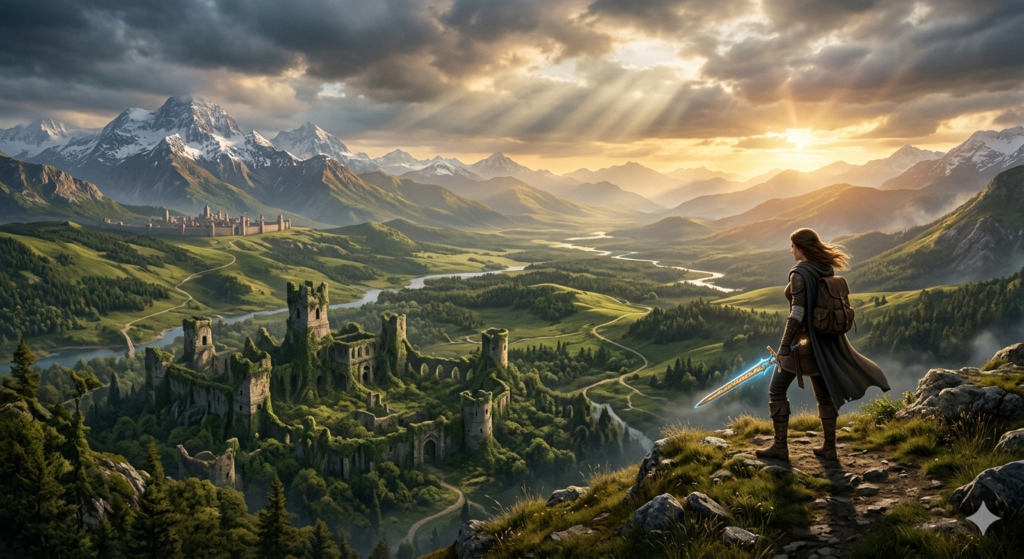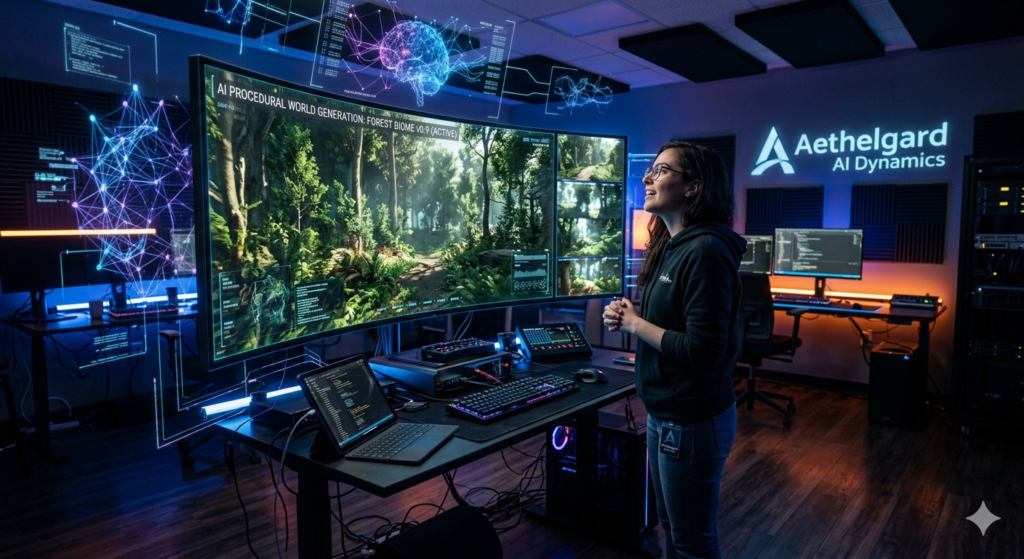
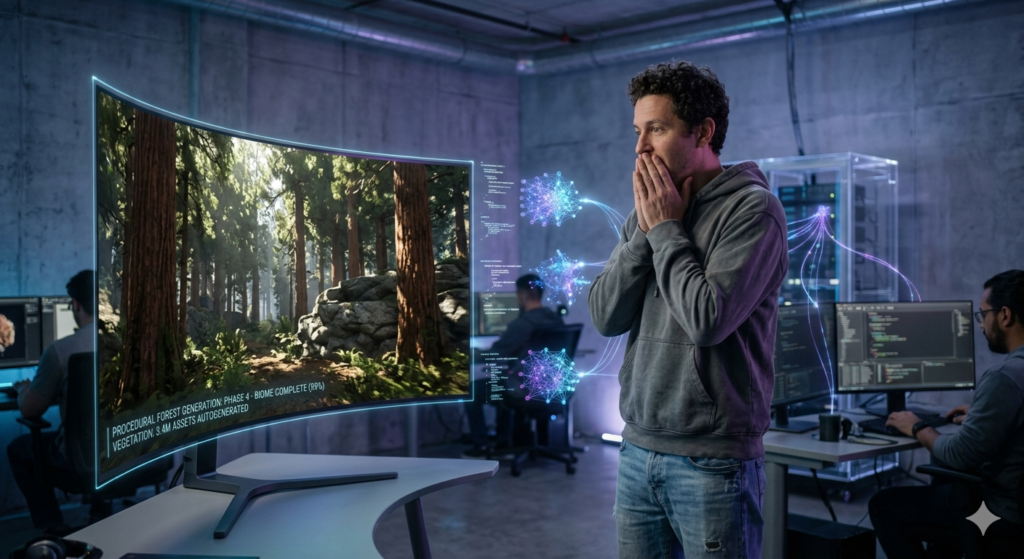
AI isn’t just in your games — it’s building them. Here’s how artificial intelligence is transforming game development in ways that will surprise you.
How AI Is Changing Game Development — And What It Means for Players
A few months ago, I was watching a behind-the-scenes video from a mid-sized game studio. The developer on screen pulled up a tool, typed a short description — something like “abandoned warehouse, industrial feel, slightly overgrown” — and within seconds, a fully textured 3D environment appeared on the screen.
Not a sketch. Not a rough draft. A complete, usable game environment.
I had to rewatch it twice because I couldn’t believe it was real. But it was. And it’s becoming the norm.
AI isn’t just in your games anymore (though it’s certainly there too — smarter enemies, better NPCs, more reactive worlds). It’s in the studios building those games. And the implications are huge — for developers, for indie creators, and for us as players.
The Old Way of Making a Game
To understand why this matters, you have to appreciate how brutally labor-intensive game development has always been. A single AAA game might take five to seven years to build. Hundreds of artists, writers, programmers, and designers all working simultaneously. Enormous budgets. Enormous risk.
And despite all that, a huge chunk of that time was spent on what developers call “grunt work” — creating the thousands of individual assets that fill a game world. Rocks. Trees. Furniture. Door textures. Loading screen art. The stuff players never consciously notice, but would immediately feel if it were missing.
AI is eating that grunt work for breakfast.
Asset Generation: The Biggest Shift
The most visible change right now is in asset creation. Tools like NVIDIA’s AI-powered design suite, Stability AI’s game-specific models, and a growing number of proprietary studio tools can now generate:
- 3D models from text descriptions
- Textures from rough concept sketches
- Voiceover lines from written dialogue
- Background music variations based on mood and tempo parameters
- Level layouts based on gameplay constraints
A single artist using these tools can now produce what used to require a small team. That’s not nothing. For indie developers especially, this is genuinely revolutionary — it levels a playing field that has historically been dominated by studios with deep pockets.
Smarter NPCs: The Quiet Revolution
But the changes aren’t just behind the scenes. Inside the games themselves, AI is doing something fascinating with the characters that populate these worlds.
The old NPC system was basically a script. Walk into a town, press a button, get three dialogue options. The NPC reads from Option A, B, or C. You leave. Everyone forgets the interaction.
Now? Several studios are experimenting with large language model-powered NPCs that can actually hold conversations. That remember what you told them last session. That react to things happening in the world around them.
I tested a demo from one studio where a guard NPC recognized that I’d been sneaking around suspiciously in a previous session and confronted me about it the next time I entered town. It was oddly unsettling. In a good way.
Dynamic Storytelling
Here’s where it gets really interesting from a player experience standpoint. AI is starting to be used for dynamic narrative generation — stories that adapt in real time based on your specific playthrough.
Traditional branching narratives are expensive because every branch has to be manually written, acted, and recorded. You can only branch so many times before the budget explodes. AI can potentially fill in the gaps — generating contextually appropriate dialogue, describing unique events, even crafting minor subplots that respond to your particular play style.
It’s still early days. The results can be clunky. But the direction is clear: games in the near future will feel increasingly personal. Your experience won’t just be “one of three endings.” It’ll be genuinely yours.
The Concerns Worth Talking About
This wouldn’t be an honest article if I didn’t acknowledge the uncomfortable parts.
AI in game development isn’t without controversy. There are real concerns about:
Job displacement. If an AI can generate concept art in seconds, what happens to the concept artist? Studios are navigating this differently — some view AI as a tool that frees artists to focus on higher-level creative work, others have quietly reduced their art teams. The reality is probably somewhere in the middle, but it’s not a comfortable conversation.
Homogenization. When everyone uses similar AI tools trained on similar datasets, do games start feeling the same? It’s a valid worry. The texture of handcrafted art — the imperfections, the personality — is something AI still struggles to replicate.
Data and consent. Many early AI art tools were trained on copyrighted artwork without artist consent. The legal and ethical fallout from this is still unfolding.
What This Means for Players
Despite the concerns, the honest answer is: for most players, AI in game development is going to be a net positive — at least in terms of the games they’ll get to play.
More games. Faster development cycles. Richer worlds that were previously too expensive to build. Indie games with production values that would have required a publisher deal five years ago.
The era of “we couldn’t afford to make that feature” is slowly becoming “we just haven’t gotten to it yet.” AI is the reason.
The Bottom Line
Game development is changing faster right now than at almost any point in its history. AI is the engine driving that change.
For studios, it’s a survival tool and a creative accelerator. For indie developers, it’s a great equalizer. For players, it’s the reason the next few years of gaming might be the most exciting in a generation.
Just maybe hold off judgment until you’ve played the games that come out of it.