Mobile gaming is no longer just idle clickers and pay-to-win traps. Here’s an honest look at whether mobile gaming has finally matured in 2025.
Mobile Gaming in 2025: Has It Finally Grown Up?
For a long time, “mobile gaming” was kind of a punchline among serious gamers. You’d bring it up and get an eye roll. “Oh, you mean those games that spam you with notifications, drain your battery, and ask for money every fifteen minutes?”
And look — that criticism was earned. The early years of the App Store were a wasteland of manipulative monetization, predatory mechanics targeting kids, and games designed specifically to addict rather than entertain.
But here’s the thing: I’ve been playing mobile games seriously for the past year, and I think something has genuinely shifted.
The Hardware Argument
Let’s start with the device side of things, because the hardware conversation is unavoidable.
The iPhone 16 Pro runs a chip that outperforms most laptop processors from five years ago. The best Android flagships are similarly powerful. We’re talking devices capable of running console-quality graphics, complex physics simulations, and large open worlds.
The hardware has been ready for premium gaming for a few years now. What’s been slower to follow is the software — the games themselves.
That’s finally starting to change.
The Games Actually Worth Your Time in 2025
I’m going to give you a real list here — no sponsored recommendations, just games I’ve actually spent time with.
Skies Unbound is a mobile-native action RPG that somehow manages to feel like a proper console game. The combat is deep, the story is engaging, and — crucially — it respects your time. Sessions can be as short as ten minutes or as long as two hours. You don’t feel punished for playing casually.
Forge of Realms took the city builder genre and made it genuinely strategic. No energy meters. No “wait 8 hours for your building to complete.” Just pure city building strategy that would feel at home on PC.
Phantom Collective is a tactical RPG that launched this spring and immediately became one of my most-played games across any platform. The grid-based combat is excellent, the character roster is interesting, and the narrative has actual stakes.
What do all three of these have in common? They charge a flat upfront price and don’t beg you for more money after that. Revolutionary concept, I know.
The Monetization Problem (Still Exists, But There’s Hope)
Let me be honest — the predatory monetization model hasn’t disappeared. Free-to-play mobile games with aggressive in-app purchases are still everywhere. They’re still making enormous amounts of money. The market rewards bad behavior, and that’s not changing overnight.
But a counter-culture has developed. Players are increasingly savvy about recognizing and avoiding manipulative mechanics. Review culture on app stores has evolved — “pay-to-win” is now a commonly understood concept that users explicitly call out. And a growing segment of mobile gamers actively seeks out premium-priced titles with no monetization strings attached.
This demand signal is being noticed. More premium mobile games have launched in the last 18 months than in the previous five years combined.
The Controller Revolution
One thing that’s massively changed the mobile gaming experience? Bluetooth controllers.
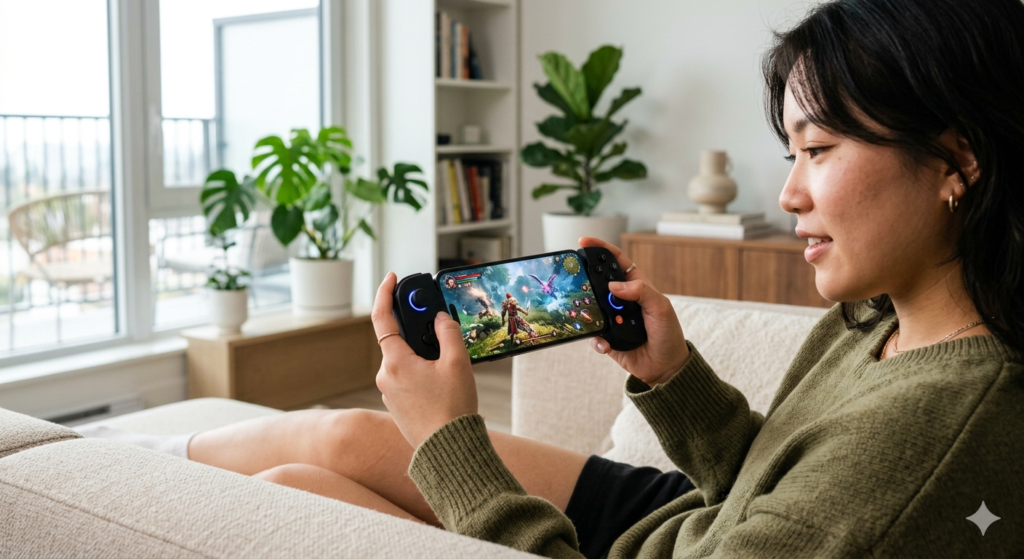
Modern smartphones work seamlessly with Xbox and PlayStation controllers. There are also purpose-built mobile controllers from Razer, Backbone, and others that clip onto your phone and give it a handheld console feel.
Playing a complex RPG with a proper controller on a six-inch screen is a genuinely excellent experience. It removes one of the main legitimate complaints about mobile gaming — that touchscreen controls are imprecise and frustrating for anything beyond simple games.
If you write off mobile gaming, pick up a Backbone One and spend an hour with a quality game on it. I suspect your opinion will shift.
Cloud Gaming’s Role
We shouldn’t talk about mobile gaming without mentioning cloud streaming. Xbox Game Pass Ultimate’s cloud gaming feature, PlayStation Remote Play, and NVIDIA GeForce NOW have all significantly improved over the past couple of years.
You can now stream full console games to your phone with relatively low latency (assuming a good Wi-Fi connection). This technically isn’t “mobile gaming” in the traditional sense — the game is running on a server somewhere, not on your device — but the player experience is similar.
For people who already subscribe to these services, it means your phone is suddenly capable of playing any game in those libraries. That’s a compelling proposition.
Has It Grown Up?
So — the question posed by the headline. Has mobile gaming finally matured?
My honest answer: partially. The best mobile games today are genuinely excellent and deserve to be taken seriously. The hardware is there. The creative talent is there. A segment of the market is demanding and getting better experiences.
But the dominant business model in mobile gaming is still extraction. The most downloaded and highest-grossing apps are still largely designed around psychological manipulation rather than genuine entertainment value.
The grown-up part of mobile gaming exists. It’s just not the loudest part yet.
If you’re willing to look for it — and spend a few dollars upfront instead of waiting for the “free” trap — you’ll find some of the best games available on any platform.