We compared ChatGPT, Gemini, and Microsoft Copilot in real daily use. Here is the honest verdict on which AI app is best in 2025.
ChatGPT vs Gemini vs Microsoft Copilot: Which AI App Is Actually Winning in 2025?
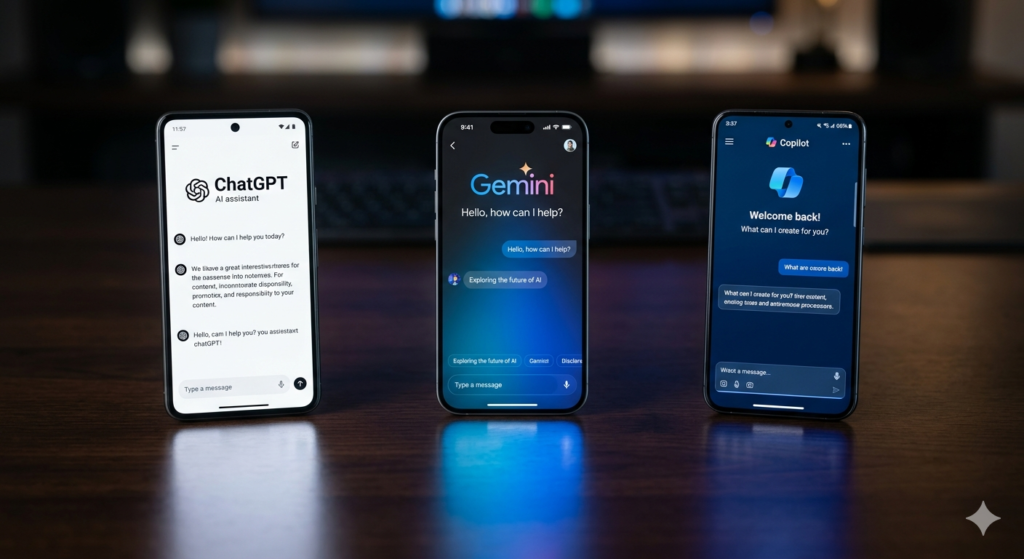
There are now three genuinely serious AI assistant apps competing for the same space on your phone and desktop. ChatGPT defined the category. Google Gemini has the search infrastructure and user data of the world’s most used tech company behind it. Microsoft Copilot is embedded directly into Windows, Office, and Edge. All three have free tiers, all three have paid upgrades, and all three have gotten meaningfully better in the last twelve months.
I tested all three as daily drivers across real tasks over eight weeks — writing, research, coding, creative work, and the kind of quick-answer lookup that used to mean opening a browser. Here is what I actually found.
ChatGPT — The Standard Everything Is Measured Against
ChatGPT remains the most capable general-purpose AI assistant for complex tasks. GPT-4o — the model currently powering the Plus tier — handles long-form writing, nuanced reasoning, code debugging, and multi-step problem solving better than either competitor. The custom GPTs feature lets you build specialized assistants for specific workflows, which has become genuinely useful for professionals with repetitive structured tasks.
The free tier is more generous than it was a year ago and gives access to GPT-4o with some daily limits. The Plus subscription at $20/month unlocks full access, voice mode, image generation via DALL-E, and the web browsing tool.
Where ChatGPT still falls short: real-time information is gated behind a browsing toggle that is not always seamless, and the app experience on mobile is functional but not as polished as it could be. The memory feature — allowing the AI to remember things about you across conversations — is improving but inconsistent.
Google Gemini — Fast, Deep, and Surprisingly Good
Gemini has made the largest year-over-year improvement of the three. Twelve months ago it felt like a capable but slightly behind-the-curve ChatGPT alternative. Today, Gemini 1.5 Pro and the newer Gemini 2.0 models are genuinely competitive for research-heavy tasks, and in one specific area — multimodal capability — Gemini is arguably the best available.
Gemini’s ability to process images, PDFs, spreadsheets, and long documents within a single context window is exceptional. Upload a 50-page research paper and ask specific questions about it; Gemini handles this more smoothly than either competitor. The integration with Google Workspace — Gmail, Docs, Sheets, Calendar — is seamless in a way that neither OpenAI nor Microsoft can quite match for pure Google ecosystem users.
The Gemini app on Android in particular feels native and well-designed. Google has the distribution advantage — it is available as the default assistant replacement on every Android device, which means adoption will grow regardless of active user choice.
Microsoft Copilot — The Enterprise Powerhouse
Copilot’s unique selling point is its integration depth. If you live inside Microsoft 365 — Word, Excel, PowerPoint, Outlook, Teams — Copilot is embedded directly where you work rather than being a separate app you context-switch to. This changes the workflow fundamentally. Summarize an email thread without leaving Outlook. Draft a presentation from a bullet list inside PowerPoint. Analyze a spreadsheet formula without opening a chat window.
The free version of Copilot is powered by GPT-4 and is genuinely capable for everyday tasks. The Microsoft 365 Copilot subscription ($30/user/month for business) unlocks the full Office integration, and for teams already paying for Microsoft 365, the incremental cost calculus is different from comparing it to standalone AI subscriptions.
For pure AI conversational quality outside the Office context, Copilot trails ChatGPT on complex reasoning tasks. But the integration story is compelling enough that enterprise users should not dismiss it as a lesser option — it is a different kind of tool.
Side-by-Side Ratings
ChatGPT
Reasoning Depth ██████████ 10/10
Writing Quality ██████████ 10/10
Mobile Experience ███████░░░ 7/10
Real-Time Info ████████░░ 8/10
Value (Free Tier) ████████░░ 8/10
Google Gemini
Reasoning Depth ████████░░ 8/10
Multimodal Tasks ██████████ 10/10
Google Integration ██████████ 10/10
Mobile Experience ██████████ 10/10
Value (Free Tier) █████████░ 9/10
Microsoft Copilot
Office Integration ██████████ 10/10
Enterprise Features ██████████ 10/10
Reasoning Depth ███████░░░ 7/10
Standalone Use ███████░░░ 7/10
Value (Free Tier) ████████░░ 8/10
Final Verdict
Choose ChatGPT Plus if you need the most capable AI for complex, creative, and technical tasks. Choose Gemini Advanced if you are deep in Google’s ecosystem or need best-in-class document and multimodal analysis. Choose Microsoft 365 Copilot if you live in Office apps and want AI that works where your documents already are.
For pure AI capability, ChatGPT still leads. For ecosystem integration, Gemini and Copilot each win in their respective worlds. There is no single winner — only the right tool for your specific workflow.