
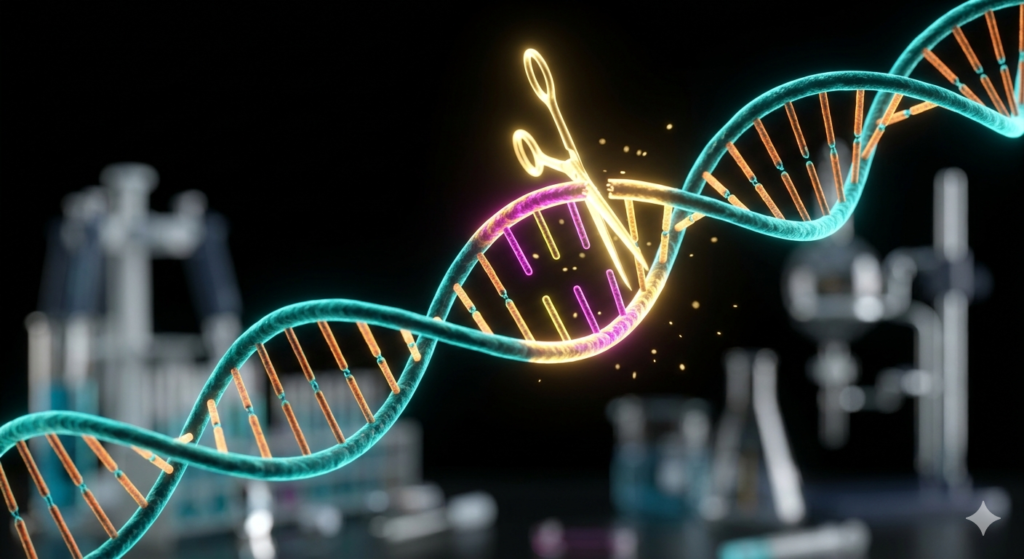
CRISPR has moved from lab experiments to real treatments. Here’s what’s actually happening with gene editing and what it could mean for human health.
CRISPR in 2025: The Gene Editing Breakthroughs Actually Changing Medicine
When CRISPR-Cas9 was first described as a potential gene editing tool around 2012, it sounded more like science fiction than medicine. The idea that you could find a specific sequence of DNA in billions of base pairs, cut it precisely, and replace it with something else — with a tool derived from bacterial immune systems — seemed almost too elegant to be real.
Thirteen years later, the first CRISPR-based treatments are approved and in use. Real patients. Real diseases. Real outcomes.
This isn’t future tense anymore.
The First Approved CRISPR Treatment
In December 2023, the FDA approved Casgevy — the first CRISPR-based treatment ever approved anywhere in the world. It treats sickle cell disease and transfusion-dependent beta-thalassemia, two serious blood disorders caused by mutations in the hemoglobin gene.
The treatment involves taking a patient’s own stem cells, editing them with CRISPR to effectively reactivate the production of fetal hemoglobin (which isn’t affected by the disease-causing mutation), and reinfusing them. Early results have been remarkable — many patients who received the treatment have been essentially cured, experiencing no painful crises or requiring transfusions after treatment.
The price tag is extraordinary — approximately $2.2 million per patient — which raises obvious questions about accessibility that the medical and policy communities are still working through. But as a proof of concept that CRISPR can safely and effectively treat human genetic disease, it is definitive.
What’s Coming Through the Pipeline
The approved treatment is just the beginning. The CRISPR clinical pipeline is substantial and expanding:
Cancer therapies. Multiple clinical trials are using CRISPR to engineer T-cells that more effectively attack specific cancer types. The strategy: edit the patient’s own immune cells to target their specific tumor. Early trials in blood cancers have shown significant promise.
HIV. Researchers at Temple University and others are investigating CRISPR approaches to excise HIV DNA directly from infected cells — potentially targeting the viral reservoir that makes HIV impossible to eliminate with current antiretroviral drugs.
High cholesterol (PCSK9 inhibition). A base-editing CRISPR approach (a more precise variant that changes single DNA letters rather than cutting the strand) targeting the PCSK9 gene has shown dramatic cholesterol reduction in early trials with a single treatment. This could replace daily medication for millions.
Blindness. Clinical trials for CRISPR treatment of a specific inherited form of blindness (Leber congenital amaurosis) have shown vision improvements, making this one of the first in-vivo CRISPR applications (editing cells inside the body rather than extracted cells).
The Precision Problem (And How Researchers Are Solving It)
The early concern about CRISPR was off-target effects — the editing system might cut DNA at unintended locations, potentially causing cancer or other harms. This concern hasn’t been eliminated but has been substantially reduced through advances in the technology.
Base editing (rather than double-strand cutting) reduces off-target risk by avoiding the most dangerous type of DNA break. Prime editing — a more recent development often called a “search and replace” function for DNA — is even more precise and can make small targeted changes with minimal off-target activity.
The newer generation tools are meaningfully safer than early CRISPR implementations. The clinical evidence bears this out — serious off-target effects have not been the limiting factor in trials to date.
The Ethical Questions That Don’t Have Easy Answers
No serious CRISPR discussion can avoid the harder questions.
Germline editing — changes to embryos or reproductive cells that would be inherited by future generations — crosses a line that most of the scientific community considers off-limits for clinical applications currently. The disgraced researcher He Jiankui who created gene-edited babies in 2018 was widely condemned precisely because he crossed this line without scientific, medical, or ethical justification.
The question of whether germline editing could ever be ethically justified — to eliminate heritable diseases, for instance — is genuinely contested. The precautionary case is strong. But the conversation is ongoing.
Access and equity. If gene therapies work but cost millions of dollars per patient, who benefits? If gene editing becomes powerful enough to enhance traits beyond disease prevention, does it become a technology that amplifies existing inequality?
These aren’t new concerns in medicine, but CRISPR’s power makes them more urgent.
Why This Matters Even If You’re Not a Biologist
The practical upshot: CRISPR is moving from research curiosity to medical reality faster than most expected. In the next decade, it will likely produce approved treatments for multiple serious conditions that currently have no cure.
If you or someone you care about has sickle cell disease, certain cancers, inherited blindness, or high cardiovascular risk from genetic factors — these treatments are coming, and in some cases are already here.
The era of treating genetic disease by editing the DNA that causes it has genuinely begun.